

In the world of online advertising, there’s one metric that always gives advertisers a headache: CPM Facebook ads. So, what exactly is CPM Facebook ads, and why does it play such a pivotal role in the effectiveness of your campaign? In fact, to truly master your ad costs and optimize your profits, understanding the nature of CPM is essential. Therefore, this article will not only answer the question, “What is CPM Facebook ads?” in detail, but also provide practical secrets and tips to help you minimize CPM costs and achieve the best results. Let’s explore together with Van Lam Agency.
Why is my CPM so high Facebook ads?
One of the main reasons for a high CPM is market competition. For example, during peak seasons such as Black Friday, Christmas, or major holidays, many advertisers simultaneously invest a significant amount of money in the platform to reach their customers. As a result, the supply-demand imbalance drives ad costs up. In addition, if you’re targeting a very narrow or high-value audience, the CPM will also be higher, since you’re competing with rivals who are willing to pay more to acquire quality leads.
Additionally, ad quality plays a significant role. If your ad has an unattractive image, irrelevant content, or a low engagement rate (likes, comments, shares), Facebook’s algorithm will give it a low rating. In this case, to reach 1,000 people, Facebook will require a higher cost.
What is CPM Facebook ads?
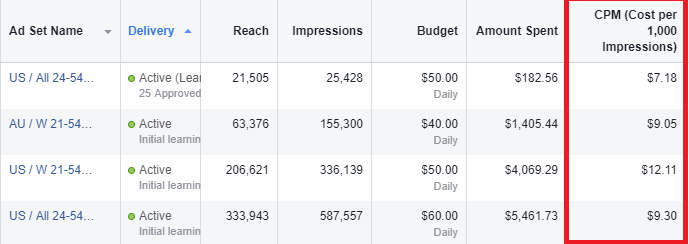
CPM is an acronym for “Cost per 1000 impressions,” which means the cost paid for every 1,000 ad displays. This is a metric that measures the cost an advertiser must pay for their ad to appear 1,000 times on a user’s screen. Each time an ad is displayed, whether the user clicks on it or not, it counts as an “impression.” Before launching, an advertiser sets a bid they are willing to pay for every 1,000 appearances of their ad. The ad’s position and time of display will depend on the platform’s algorithm (like Facebook’s) and the level of market competition. CPM is a basic measure of ad cost, helping you evaluate how expensive it is to reach 1,000 people on a specific platform.
Determining a good CPM
So, how is a good CPM for Facebook ads actually calculated? As suggested, there is no specific number that is considered an absolute benchmark. However, we can use some estimated numbers as a reference.
- CPM from $5 to $10: This is the average on Facebook. If your CPM is in this range, it means your campaign is performing normally—not too outstanding, but nothing to worry about.
- CPM below $5: If you see a CPM lower than $5, you’re doing very well. This shows that you are getting your message out to a lot of people without spending too much.
- CPM above $10: This is when you need to reconsider your campaign. A high CPM can be a sign that there’s a problem, and it’s time to optimize.
The important thing is to consider CPM in a specific context. A high CPM is not necessarily bad if your campaign is getting good results. If you are selling high-value items and your ads are generating good profit, a CPM of $20 can still be acceptable. What’s truly important is whether you are achieving a return on ad spend (ROAS).
The secret to lowering CPM for advertisers in 2025
What is CPM Facebook ads? This is a question every advertiser cares about, because CPM is one of the most important metrics reflecting your ad costs. In previous years, many believed that the secret to lowering CPM when running ads on Facebook lay in meticulously fine-tuning the target audience. However, 2025 marks a major change in how Facebook operates, and the secret to a low CPM is no longer there. Now, advertisers need to shift their focus to more effective strategies.
The mistake of targeting
Many advertisers often spend 100% of their energy on finding the perfect target audience. They painstakingly test age, gender, interests, and behaviors, believing that the more detailed the targeting, the higher the effectiveness. However, this is a big mistake in the current context. A typical example is local businesses. With a business operating in a certain area, they already have a clear target audience (the people in that area), and it’s almost impossible to optimize the ad set to lower the CPM.
The ad set structure between campaigns doesn’t really change. They may share the same name and audience segment, but everything else is identical. This proves that the secret to lower CPM Facebook ads no longer lies in the ad set. Today, Facebook uses powerful machine learning to automatically find people most likely to engage and convert. As a result, advertisers no longer need to waste time testing outdated targeting options.
The impact of ad content
If the secret isn’t in the ad set, then where is it? The reason is that successful advertisers now are focusing 100% of their energy on ad content and visuals. This is the core factor that helps to reduce CPM in a breakthrough way. Facebook’s algorithm prioritizes ads with high engagement rates. When your ad prompts users to engage, such as leaving comments, liking, sharing, or watching a video, Facebook recognizes that the ad is valuable and wants to show it to more people at a lower cost.
Real results prove this clearly. For example, if two campaigns target the same audience, but one pays only $6 per message while the other costs $19, the difference comes from the ad content. The successful campaign used a smart strategy, persuasive copy, and eye-catching visuals. You don’t always need complicated videos or big productions—sometimes, simple but unique images that grab attention and spark curiosity can deliver excellent results.
Implementing the Facebook Conversion API
Using technology is also an important secret to lowering CPM. While the Facebook Pixel is limited by browsers and ad-blocking software, the Facebook Conversion API (CAPI) was created to solve this problem. CAPI allows you to send conversion data directly from your server to Facebook, bypassing browser restrictions and ensuring the data is collected as completely and accurately as possible.
Accurate data from CAPI is the key for Facebook’s algorithm to work effectively. When Facebook has enough data about important user actions (like purchases, form fills, etc.) on your website, it can optimize ad delivery to reach users who are most likely to convert. As a result, your ads will be shown to the right people at the right time, which increases the conversion rate and significantly reduces CPM.
Implementing CAPI also allows you to create more powerful remarketing audiences. With a high-quality customer dataset, you can more effectively re-engage people who have interacted with your business, and these campaigns often have a lower CPM because the users are already familiar with the brand.
A few necessary notes about CPM
A high CPM is not always a bad sign, and conversely, a low CPM is not necessarily a success. The important thing is to put CPM in the right context of the entire campaign. The key lies in connecting CPM with your campaign’s objective. If you only want to raise brand awareness, a low CPM may be your main focus. But if you’re looking for conversions and sales, you may be willing to accept a higher CPM if it brings good conversion results.
Ad scheduling limit
CPM can fluctuate significantly depending on the time of day and day of the week. Peak hours, when many users are online or many advertisers are bidding at the same time to display ads, will often have a higher CPM. However, that can also be when your target audience is most active and ready to engage.
Ad scheduling is a smart strategy to optimize spending efficiency. Instead of running ads 24/7, you can analyze data to identify the golden hours, when the ads bring the highest CTR and conversion rate. By focusing your budget on these periods, you can accept a slightly higher CPM but achieve superior overall effectiveness. Consider the CPM trend over time instead of worrying about daily changes.
Ad placement settings

Ad placement settings also directly affect CPM. Each ad placement on platforms like Facebook, Instagram, or the Audience Network has a different level of competition and value. For example, an ad displayed on the News Feed usually has a higher CPM than one in Stories or on the Audience Network. However, the News Feed placement often provides a higher level of visibility and engagement, which can lead to better conversion rates.
This re-emphasizes the importance of not just looking at CPM. You should test different ad placements and analyze not only the cost but also the performance in terms of CTR and conversion rate for each placement. You may find that a placement with a low CPM doesn’t bring results, while a placement with a higher CPM is a “golden goose” for your business.
Bid adjustment
A campaign with a high CPM but also a high click-through rate (CTR) shows that your ad is extremely effective at attracting users, even if you have to pay more for each impression. You are reaching a lot of users at a low cost, but if they don’t take action, that’s not a real victory. Ad platforms offer different bidding strategies, from optimizing for impressions (cost per impression) to optimizing for specific actions like conversions.
If your goal is to maximize impressions, you can use a bidding strategy based on impressions. However, if you want sales or lead generation, it’s better to optimize for conversions. This often makes CPM Facebook ads higher, but at the same time lowers your cost per acquisition (CPA), which increases overall profit. In short, don’t worry about paying a higher CPM if it helps you reach a quality audience and drive real business results.
As an official partner of leading platforms like Facebook, Google, and TikTok, Van Lam Agency is proud to provide reputable and high-quality ad account rental solutions, helping businesses optimize their performance. Our diverse system of ad resources, which are meticulously nurtured and technically optimized, ensures that your campaigns always run stably and sustainably, outperforming regular accounts.
When working with Van Lam Agency, you can run ads with complete peace of mind. You won’t need to worry about setup, account verification, or technical issues. All of our ad accounts are fully verified, highly trusted, and managed through premium systems such as BM Agency, MCC Agency, and TikTok Agency. This ensures higher approval rates and reduces risks like checkpoints or sudden account locks—even for large-budget campaigns. In addition, our expert team provides full support, from strategy consulting and campaign setup to ongoing ad tracking and optimization.
Conclusion
So, understanding what CPM Facebook ads are is the key to mastering costs. Don’t just look at one number; consider CPM in the comprehensive context of the campaign, focusing on content quality and new technologies to achieve sustainable business results. We hope the information in this blog post will help you optimize your Facebook ads and minimize your ad costs.
Frequently Asked Questions
What is considered a good CPM on Facebook?
A good CPM typically ranges from $5 to $15, but it depends on your industry, audience, and competition. Lower CPM means you’re reaching more people at a cheaper cost.
How do you calculate CPM in Facebook Ads?
The formula is: CPM = (Total Spend ÷ Total Impressions) × 1,000.
For example, if you spend $50 and get 10,000 impressions, your CPM is $5.